
Example: He won the silver medal.
The simple past tense shows that you are talking about something already happened. Unlike the past continuous tense, which is used to talk about past events that occurred over time, the simple past tense emphasizes that the action is finished.
Example: Wolfgang admired the way the light glinted off his silver medal.
You can also use the simple past to talk about a past state of being, such as how someone felt about something. This is often expressed with the simple past tense of the verb to be and an adjective, noun, or prepositional phrase.
Example: The contest was the highlight of his week.
How to Formulate the Simple Past
For regular verbs, add -ed to the root form of the verb (or just -d if the root form already ends in an e):
Play→Played Type→Typed Listen→Listened Push→Pushed Love→Loved
For irregular verbs, things get more complicated. The simple past tense of some irregular verbs looks precisely like the root form:
Put→Cut→Cut
Set→Set
Cost→Cost
Hit→Hit
For other irregular verbs, including the verb to be, the simple past forms are more erratic:
See→Saw
Build→Built
Go→Went
Do→Did
Rise→Rose
Am/Is/Are→Was/Were
The good news is that verbs in the simple past tense (except for the verb to be) don’t need to agree in number with their subjects.
Example: Wolfgang polished his medal. The other winners polished their medals too.
Common Regular Verbs in the Past Tense
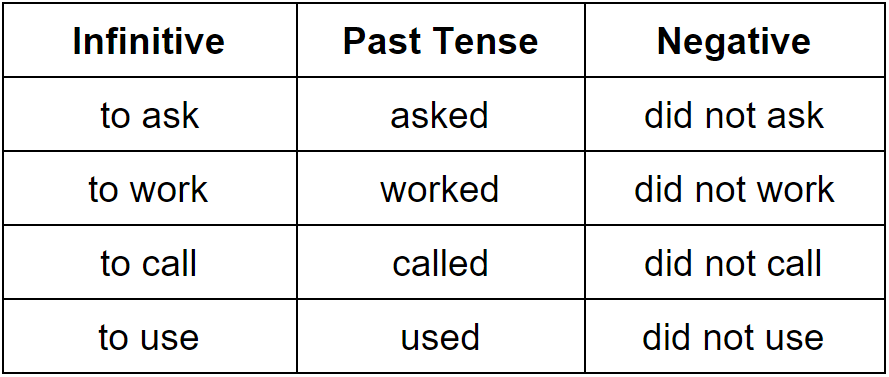
Common Irregular Verbs in the Past Tense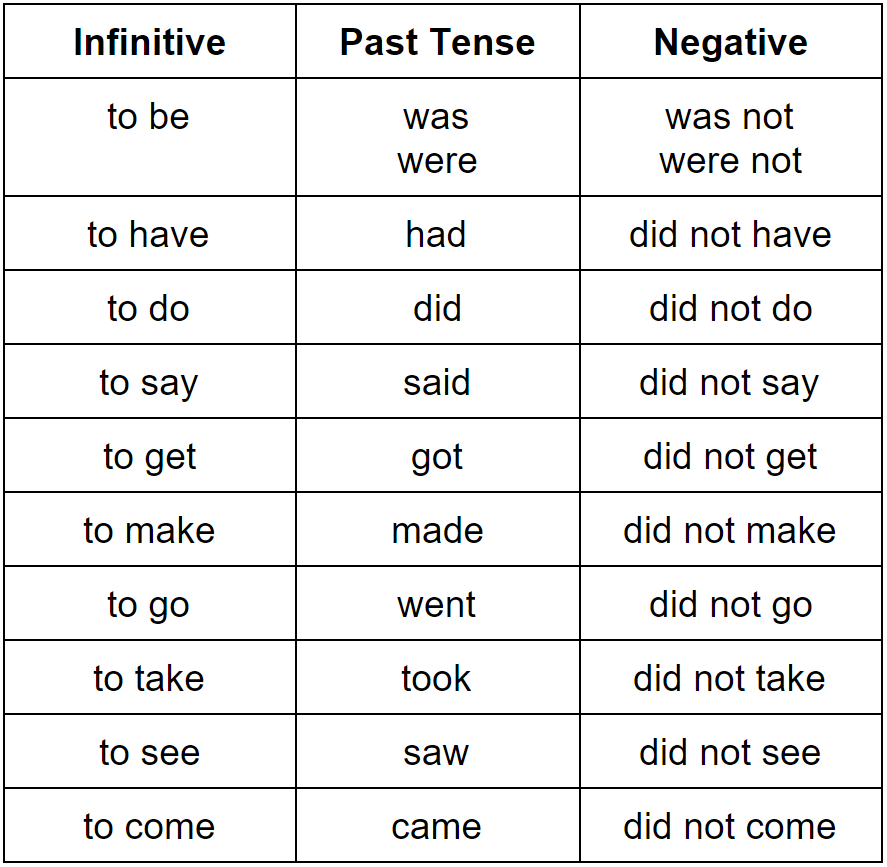


.png)
.png)
No comments:
Post a Comment